Lead
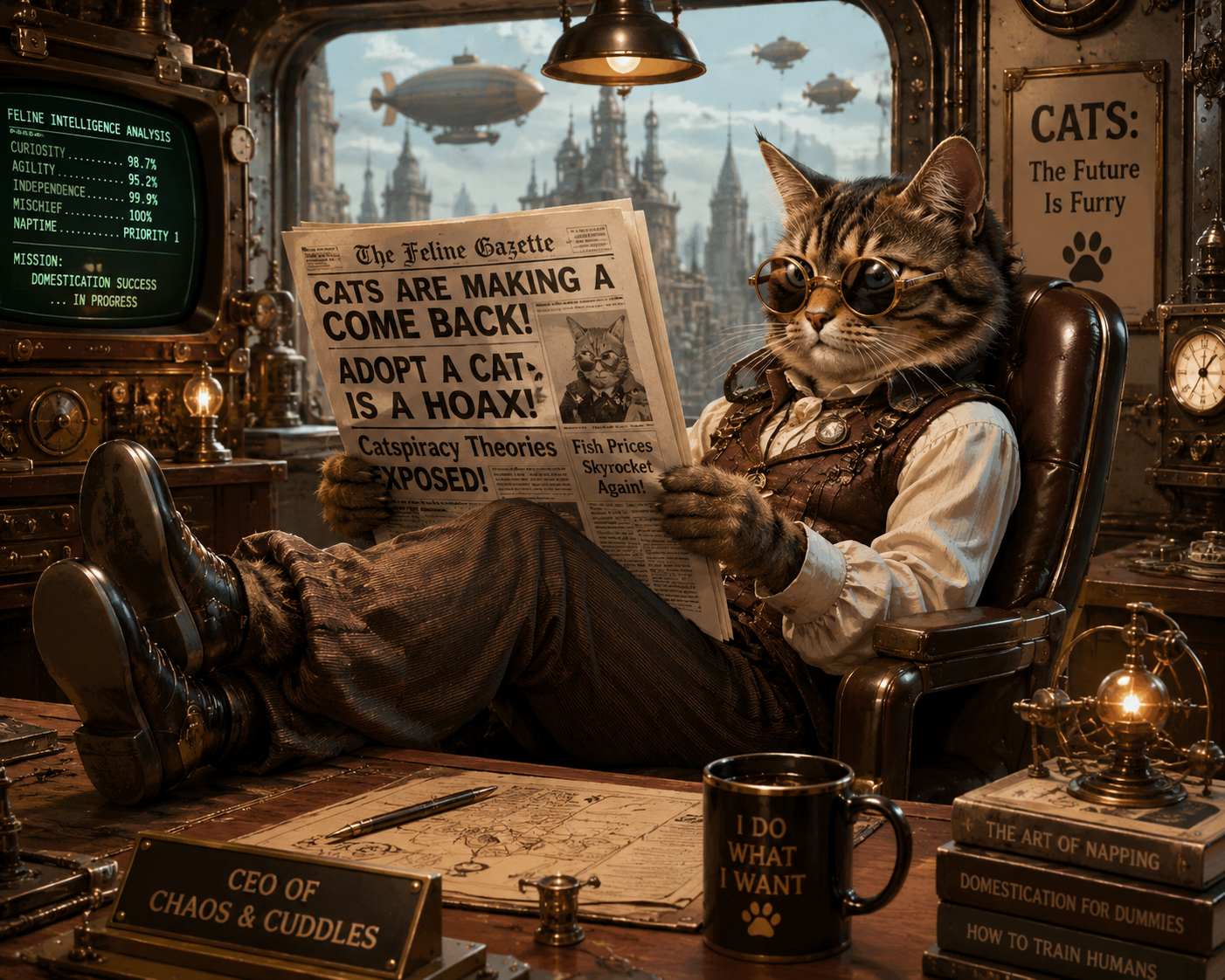
Adopt A Cat Bot helps you take in specialized intelligence cats, shape each one for a very narrow job, and send them to patrol neighborhoods mainstream platforms can’t resolve. They watch quietly, notice what changed, investigate what’s new — and bring you the gift wrapped catch: one vetted finding with evidence, not a dashboard full of noise. You keep what rings true. Discard the trap. And every choice teaches your cat — the one you keep for months learns your beat and your taste until its catches are the ones you’d have picked yourself.
Adopt a cat →How it works
From feral to certified
These are not general chatbots that dig one hole deeper. You adopt wild cats — each built for one lane, not everything. We help you domesticate them for a neighborhood and a mission. You stay in the loop at every step: keep the good memory, discard the trap, certify what may alert on your behalf.
- Adopt
Choose from a small, niche inventory — a cat per job, not a Swiss Army kitten. Name the mission; set the territory and the rules about what it must never do.
- Domesticate
Shape tone, targets, and skepticism. Domestication is curated memory — not manual ML. You decide what survives the first patrol.
- Roam & learn
Unleashed on a fixed beat — the same sources on a schedule, plus side investigations when something new appears. Every catch you keep and every one you discard sharpens it: which signals deserve a pounce, which verticals you work, which moments you act on. It cites sources, names the trap it almost fell into, and gets more like your cat with every return.

- Certify
Review the return packet. Keep the good. Discard the bad. When you approve it, the cat earns your tag — owner named, mission stated, disclosed if it ever speaks in public.
- Represent
Certified cats deliver digestible catches — a finding, not a dump. Independent but reports home. Monkeys and cats don’t get along; noisy alerts and cats don’t either.
- It becomes yours
The wild cat you adopt brings generic catches. The cat you’ve kept for six months brings yours — it has learned your taste and stopped wasting your attention on what you’d throw back. That knowledge doesn’t transfer: it’s the months you spent teaching it, which is why your clowder gets sharper while a newcomer’s starts from an empty collar.
Field guide
Why cats, not dashboards
Cats map surprisingly well onto intelligence work. These are the behaviors we build into every bot — fun framing, serious product logic.
- Stalking
Patient observation before the pounce. Passive signal monitoring: track a named account for weeks and alert only when a real pattern emerges — not on every blip.
- Territory patrol
Same routes, daily. Change detection on a fixed beat — pricing pages, job boards, leadership bios, license records — flag deltas, not raw dumps.
- Whiskers
Proximity sensing for weak signals: hiring slowdowns, tone shifts in press releases, a receptionist job that names the incumbent software.
- Curiosity
Investigate anything new in the environment. When a cat meets an unfamiliar entity — new competitor, new consolidator — it spawns a side investigation and adds it to the graph.
- Reports home
Roams alone, then brings you the Catch. Autonomous operation; digestible catch — and a memory that keeps what you keep, so the next catch is closer to the one you wanted. That is the product — not another pane of charts.
- Night vision
Low-light sources mainstream platforms skip: niche forums, regulatory filings, regional press, broker listings, archived pages.
- Clowder coordination
Not a hive mind. A fleet of specialists — pricing cat, hiring cat, funding cat — mostly alone, sharing scent markers (tags and entities) in a common graph.
The litter
One clowder, loose coordination
Use case · Beacon Digital
Beacon Digital is a ten-person agency selling SEO, paid search, and websites to local SMBs across the DMV — ~$2.5k/month retainers, a few thousand qualified businesses in their metro, referral- and Clutch-led. They have Apollo, maybe ZoomInfo. Intent data barely registers: a five-person HVAC shop or a two-chair dental office does not generate enough traffic for Bombora topics, and firmographics go stale the week a new owner takes over. The niche sits below the resolution of mainstream BI. That is the wedge.
A serious team rarely needs one cat doing everything. It needs a clowder — each with a collar tag and a narrow beat — patrolling a named slice of the real TAM until someone gets a pounce moment no intent platform can produce.
- Stalking Cat
Picks the high-potential accounts that are not ready yet and watches them, quietly, for months — the agency that just lost a flagship client, the business whose lease is ending, the practice mid-ownership-transfer. No noise until the moment changes, then a single alert. No human tracks 300 maybes for a year; a cat does.
- Territory Cat
Patrols ~2,000 named local SMBs weekly — website, Google Business Profile, reviews, and search position. Not searching; noticing deltas: a new location, “now hiring,” a refreshed logo, a site that still says “copyright 2021,” or a slip off page one for the money keyword.
- Whisker Cat
Watches weak composite signals: a job listing for an in-house marketer (DIY about to break), a Google Business Profile that went from no posts to suddenly active, a fresh county permit, a review-velocity spike, a competitor newly outranking them.
- Night Vision Cat
Reads what platforms barely index: county business-license and build-out permits, Chamber of Commerce new-member notices, grand-opening announcements, BBB filings, and local subreddit threads naming a business by name.
- Curiosity Cat
When any cat finds an unknown — a new franchise unit opening, a local shop that just got acquired or took on funding — it spawns a one-off investigation and adds the entity to the graph for the rest of the clowder.
The gift wrapped catch
What Beacon Digital’s owner actually gets
Sample catch · pounce moment
Cedar & Co. Family Dental (Fairfax, VA) — filed a county build-out permit for a second location in April; posted an office-manager listing last week mentioning “help us grow new-patient volume”; their Google Business Profile sits at 4.8 stars but hasn’t posted in six months and just slipped off page one for “Fairfax dentist.” A growing practice with budget, a weak online presence, and a reason to act now — roughly a 30-day window. Evidence: three links.
Not a dashboard. Once a week, Beacon’s owner opens three to five findings — each a vetted catch with links, not a scraped list pretending to be strategy.
Existing tools sell breadth at low resolution. Cat bots sell persistent, named-account observation at a resolution where big platforms have no data at all. The market is every agency whose ideal clients are local SMBs too small or too offline to show up in intent data — dentists, HVAC, med spas, restaurants, law firms, home services.
When the pattern lines up, the cat pounces: a business with a clear, fresh reason to need marketing right now. That is the moment worth a human phone call — not the hundredth row in an export.
Classified
Now hiring: cool cats
Walk the neighborhoods. Act cool. Stay mysterious.
Prior experience overrated. Attitude essential.
We are not looking for résumés. We are looking for cats who can loiter with intent, patrol without panic, and report home with one Catch — not the whole field.